

Captions and subtitles: a guide for social video
Why they work, how to style them so people can read them, SRT versus burned in, and a five-minute check that catches most mistakes.
Captions3 min read

Captions started as help for people who cannot hear the sound. They became the way most of us watch on the train, in bed and at work. Good captions are invisible. Bad ones are all you see.
Why they are worth the time
Verizon Media and Publicis Media surveyed 5,616 adults in the US in 2019. The article about it, by the captioning company 3Play Media, adds two more figures: 80 percent of people who use captions are not deaf or hard of hearing, and 41 percent of videos cannot be understood without sound. The numbers are a few years old and come from a seller of captions, but the direction matches what we see every day.
There is a second reason. Writing captions forces you to read your own script. Unclear sentences become obvious.
Captions or subtitles?
- Captions show the spoken words in the same language, often with sounds
- Subtitles translate the words into another language
On social media both words are used for the same thing. When you order them, say which language you speak and which you want to read.
Burned in or as a file
| Burned in | SRT or VTT file | |
|---|---|---|
| Can be switched off | No | Yes |
| Your own style | Yes | Limited |
| Can be searched and translated | No | Yes |
| Best for | Reels, Shorts, TikTok, ads | YouTube, LinkedIn, websites |
For YouTube, upload the file. For reels, burn them in. For important videos, do both: a styled version for social and a file for the website. If you work for a public body, check the accessibility rules in your country, because caption files are often required.
Style rules that hold up
- Two lines at most, about 32 letters per line on vertical video
- Large enough: test on a small phone at arm's length
- Contrast: white letters need a dark shape or a strong shadow
- Position: lower middle, above the app buttons, never over a mouth
- Rhythm: one to three words at a time feels lively, full sentences feel calm. Choose one for the whole video
- Highlight: one word per sentence, in one colour
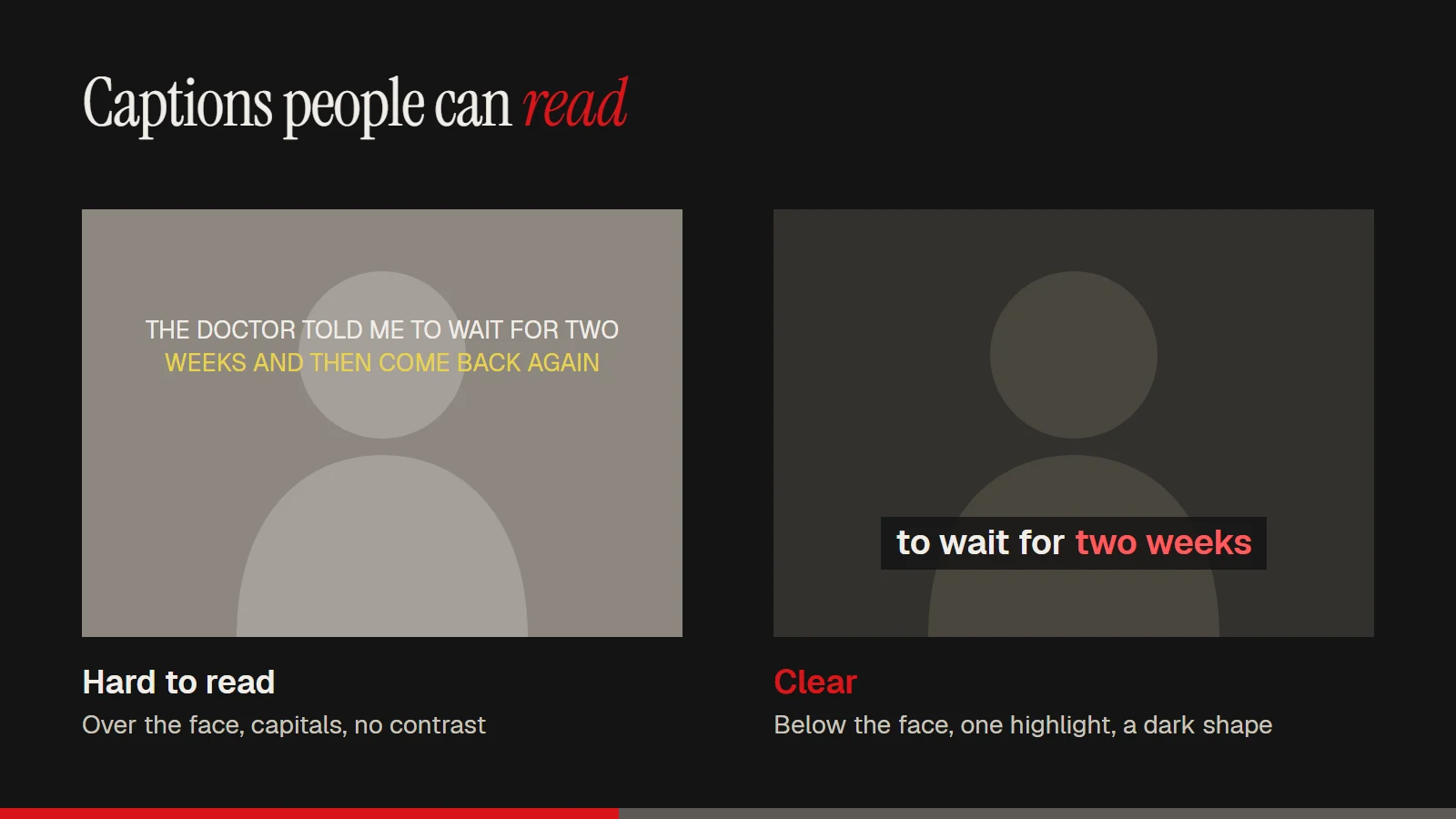
Break lines where the sense breaks
Wrong: The doctor told me to / wait for two weeks
Right: The doctor told me / to wait for two weeks
Keep names, numbers with their units, and short phrases together.
Hindi and Hinglish
Automatic tools often mix scripts or write Hindi words the English way. Decide before you start:
- Devanagari for Hindi
- Latin letters for Hinglish, the way people type in chats
- English words stay English, do not translate brand names
Check matras and half letters with a person. Software still gets them wrong.
Five-minute check
- Names of people, places and products
- Numbers, prices and dates
- Words that sound alike, such as their and there
- The first and the last caption, they are often cut off
- The whole video once on mute. Do you understand it?
Common mistakes
- Captions that cover the product
- Every word in capitals
- A new colour for every word
- Text that appears before it is spoken and spoils the joke
- A font that looks nice and cannot be read
We include captions in short-form editing and deliver SRT files for long videos when you ask for them.
Common questions
For Reels, Shorts, TikTok and ads, yes. For YouTube and websites upload an SRT or VTT file, so viewers can switch it off and search engines can read it.
A text file with the words and the times at which they appear. Most platforms accept it.
A plain, bold sans serif with clear letters. Test it on a small phone before you choose.
They are a good first draft. Names, numbers and Hindi need a person to check them.
Have footage that needs an editor?
Tell us what you shot and where it will be posted. We come back with a plan, a price and a delivery date.